
12 - Golang Performance Optimization, DuckDB 1.0.0, Full Disk and Triage Acquisition, Building with LLMs

programming
Ultimate Golang Performance Optimization Guide: Optimizing performance is essential for developing robust Golang applications that deliver great user experiences. Efficient resource use, such as minimizing memory usage and optimizing CPU utilization, is crucial. Reducing latency by improving database queries, utilizing caching, and implementing asynchronous processing enhances responsiveness. Employing performance patterns like using Goroutines for concurrency, parallelizing CPU tasks, and avoiding memory allocation in critical stages further improves performance.
Regular, Recursive, Restricted: Describing arithmetic expressions in a clear and unambiguous way using formal grammars is challenging. The post explores several methods for defining such grammars, highlighting their drawbacks in terms of clarity and ambiguity. The author proposes a novel approach: using "recursive restricted regular expressions" to define grammars for trees. This method combines regular expressions for generating valid tree structures with additional rules to restrict certain ambiguous configurations.
tool of the week: NAMO is an application that helps you run a local DNS server on your Mac. You don't have to be a network professional.
The Scrollbar Customization in CSS and JS (2024 Update): Scrollbar customization in CSS and JavaScript has evolved over time, but there are still limitations and varying levels of support across browsers. The latest updates include the scrollbar-color and scrollbar-width properties in the CSS Scrollbars Styling Module Level 1, which have good support in Chrome, Edge, and Firefox but limited support in Safari. Webkit/Blink browsers offer more extensive customization through non-standard ::-webkit-* pseudo-elements.
web
Implementing an image processing service using imgproxy: Trendyol uses a MultiCDN architecture to ensure fast, secure, and highly available content delivery. To handle the vast number of images required for their e-commerce platform, Trendyol developed their own image processing service called Vakum, which processes images on-the-fly rather than pre-storing various resolutions and formats. They transitioned from relying on third-party services to utilizing imgproxy, a tool powered by the libvips library, for its speed and scalability.
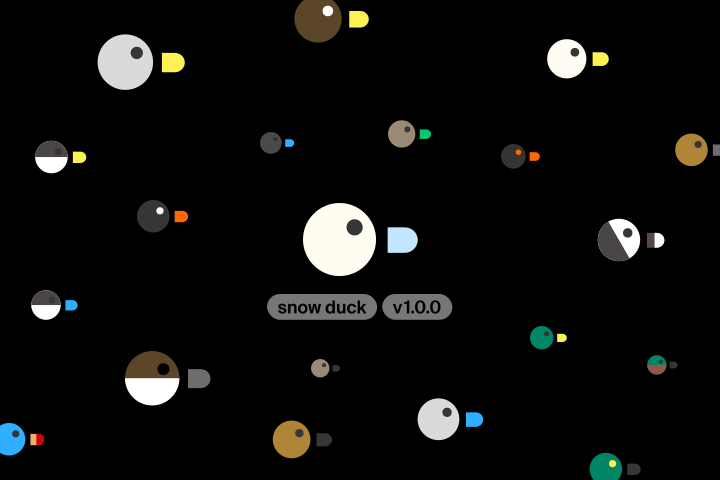
Announcing DuckDB 1.0.0: DuckDB has released version 1.0.0, codenamed "Snow Duck," marking a milestone in its development. This version focuses on stability, with significant improvements in the custom-built data storage format, ensuring backward and forward compatibility. DuckDB has gained widespread popularity, with millions of downloads and extensive community support. The project is funded through DuckDB Labs, which provides consulting and support services, ensuring long-term sustainability.
The Impact of AI and Platform Engineering on Cloud Native's Evolution: Automate Your Cloud Journey to Light Speed: The convergence of AI and platform engineering is revolutionizing cloud-native environments, enhancing scalability, reliability, and efficiency. AI technologies from Azure and Google Cloud are empowering businesses to integrate intelligent decision-making into their applications, optimize processes, and gain actionable insights. Platform engineering plays a crucial role in creating stable, scalable software platforms that support AI applications.
cyber security
An Introduction to Chrome Exploitation - Maglev Edition: Maglev is a Just-In-Time (JIT) compiler for V8, Chrome's JavaScript engine, aimed at optimizing code execution. The blog post explores the Chromium security architecture, detailing its multi-process design which enhances stability and security by isolating processes. It also explains the V8 pipeline, including parsing JavaScript into an Abstract Syntax Tree (AST), generating bytecode via Ignition, and optimizing this bytecode using the TurboFan compiler.
The Differences Between Full Disk And Triage Acquisition: In digital forensics, data acquisition is crucial and involves two methods: triage acquisition and full disk acquisition. Triage acquisition quickly collects volatile data and essential artifacts, providing immediate insights and efficiency. Full disk acquisition creates a complete bit-by-bit copy of an entire storage device, ensuring thorough analysis and data integrity, but is more time-consuming. The choice between methods depends on the investigation's needs, with triage used for rapid, broad data collection and full disk for detailed, high-severity cases.
Thousands of internet-facing devices vulnerable to Check Point VPN zero-day: A critical vulnerability in Check Point's VPNs, identified as CVE-2024-24919, has exposed thousands of devices worldwide to potential exploitation. Despite a fix being released, attempts to exploit the bug began on April 7, allowing hackers to access sensitive data and potentially gain further network privileges. Most of the affected devices are Quantum Spark Gateways, used by small and medium-sized businesses, with the majority located in Japan and Italy.
artificial intelligence
What We’ve Learned From A Year of Building with LLMs: Large language models (LLMs) have become effective enough for real-world applications, but building reliable products with them remains challenging. The guide offers insights from practical experience in developing LLM applications, covering tactical practices like prompting and retrieval-augmented generation (RAG), operational concerns like team organization and data quality, and strategic considerations like focusing on system design rather than just the model.
Fine-tune Embedding models for Retrieval Augmented Generation (RAG): Fine-tuning embedding models for specific domains enhances retrieval performance in Retrieval-Augmented Generation (RAG) applications. By leveraging Matryoshka Representation Learning, which efficiently compresses embeddings without losing significant performance, the process achieves significant storage savings and performance improvements. Fine-tuning on 6.3k samples resulted in a ~7% performance boost, demonstrating the benefits of domain-specific customization over general models.
FineWeb: decanting the web for the finest text data at scale: FineWeb-V1, a new model by Hugging Face, excels in fine-tuning web data for various NLP tasks. This model enhances retrieval and comprehension by leveraging diverse web sources, improving the accuracy and relevance of generated responses. FineWeb-V1 represents a significant advancement in handling web-based information, making it a valuable tool for applications requiring nuanced and context-rich data interpretation.